
Are supermarket salad bags safe? What's really going on inside there…
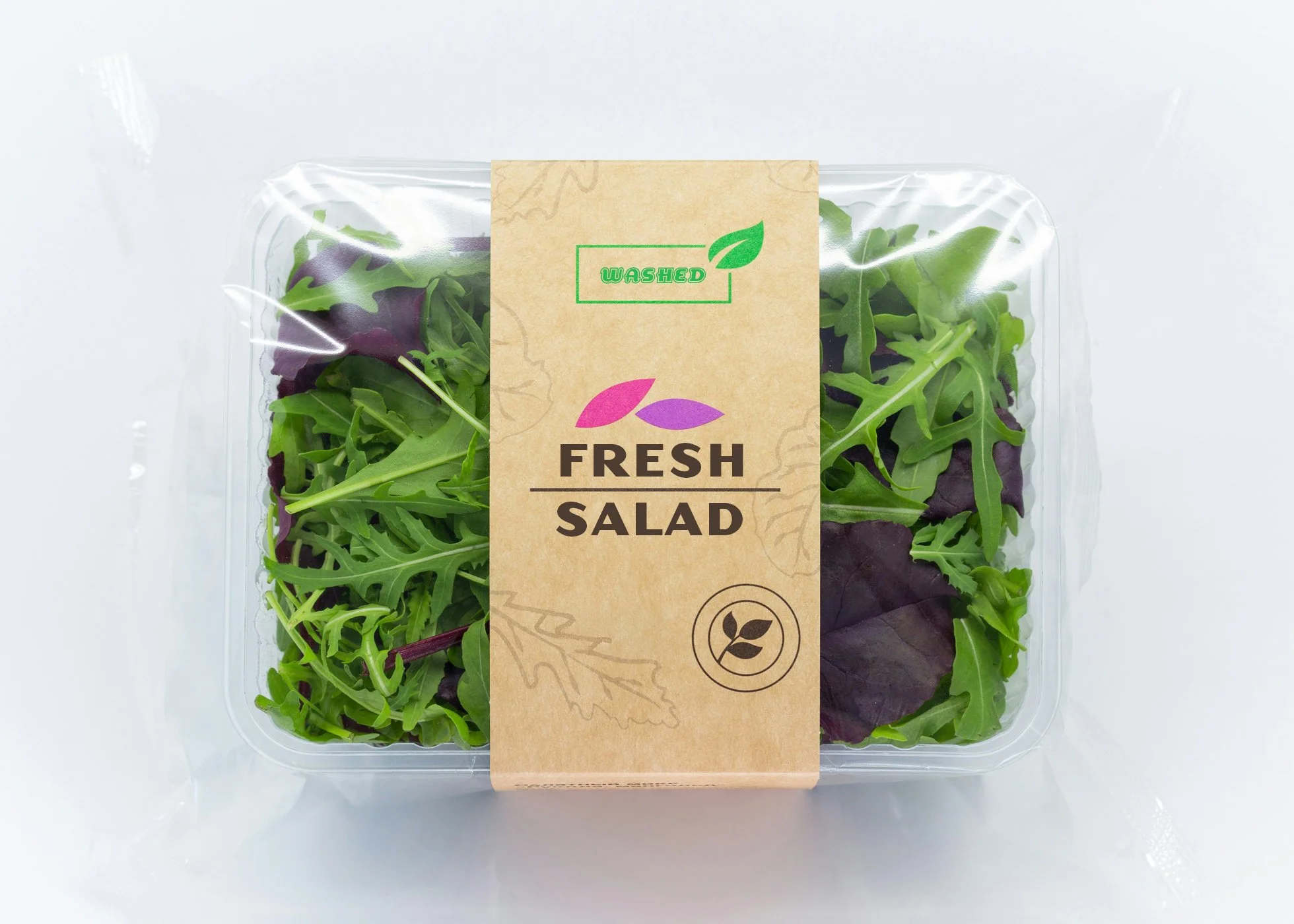
If you've ever wondered whether supermarket salad bags are as healthy as they look, you're not alone. They’re definitely convenient but what happens between the field & the supermarket shelf tells a very different story.
If you’ve been in a supermarket you’ll know that salad bags take up a large part of the supermarket aisle. It might not surprise you to hear that in 2025, 450 million bags of salad were sold in the UK. It’s convenient. There’s no washing or preparing. Health experts tell us more variety is one of the best things you can do for your health. Salad bags definitely make that easier. But what’s really going on in that bag?
Why your salad’s not as fresh as it looks
If you’re picking up a salad bag hoping to get your 5 a day or a health fix, consider a few things first. Salad bags are filled with a gas mix called Modified Atmosphere Packaging (MAP), the oxygen level is reduced & replaced with a mix of nitrogen & carbon dioxide. It’s widely used across food packaging because it extends shelf life.
The volunteers blood samples showed that the group who ate the fresh lettuce had increased antioxidant levels but those who ate the lettuce stored in MAP showed no increase at all. Eating MAP salad means you’re not getting your fix of several nutrients, like vitamin C, vitamin E, polyphenols & other micronutrients.
Chemical washing
As part of the preparation process, salad leaves are washed to remove bacteria & other contaminants. This is mostly done in chlorine although increasingly other chemicals like peracetic acid are used.
The chlorine is in a form very similar to household bleach & is at a concentration up to 20 times stronger than in a swimming pool.
The chemical wash is designed to get rid of harmful bacteria on the surface of the leaves, howevera 2018 study found the wash doesn't kill bacteria like Listeria & Salmonella, it simply makes them undetectable by traditional food testing methods while they remain dormant.
There’s also the chemical residues left on the leaves to consider. Some chlorinated compounds are known carcinogens & the specific by-products left on salad washed with chlorine have not been fully studied.
Washing with chlorine is banned in organic standards, although there’s more to this, see below section on organic salad.
Salmonella, E.coli, Listeria
Even with the chemical washing, bacterial outbreaks still happen. There’s been several E.coli & Listeria outbreaks in the UK over the last 10 years, see table below. These outbreaks were responsible for 712 confirmed cases & 11 deaths. The number of actual cases is likely to be far higher because not everyone makes an official report.
From the table below, Listeria has been the more deadly bacteria. However one of the problems with Listeria is that it’s harder to detect than Salmonella or E.coli. While Salmonella & E.coli have an incubation period of a few days at most, Listeria’s incubation period is up to 70 days, which makes it harder to trace back to the food source it came from.
The 2022 outbreak of E.coli was unusual because it was caused by heavy rainfall. The flooding that followed, carried E.coli contaminated sheep faeces into a nearby field of salad. With heavy rainfall becoming more common & monoculture farming compacting soil & reducing its ability to absorb water, outbreaks like this could become more frequent.
We haven’t had a Salmonella outbreak from salad bags for a while but they do still happen. In 2024 a Salmonella outbreak involving Italian rocket salad is highly likely to have reached UK shelves. Although there were no confirmed UK cases, that could be down to gaps in detection & reporting as much as safety procedures being followed.
It’s worth noting that none of these outbreaks were caused by growers or producers breaking the rules, in each case the rules & regulations had been followed.
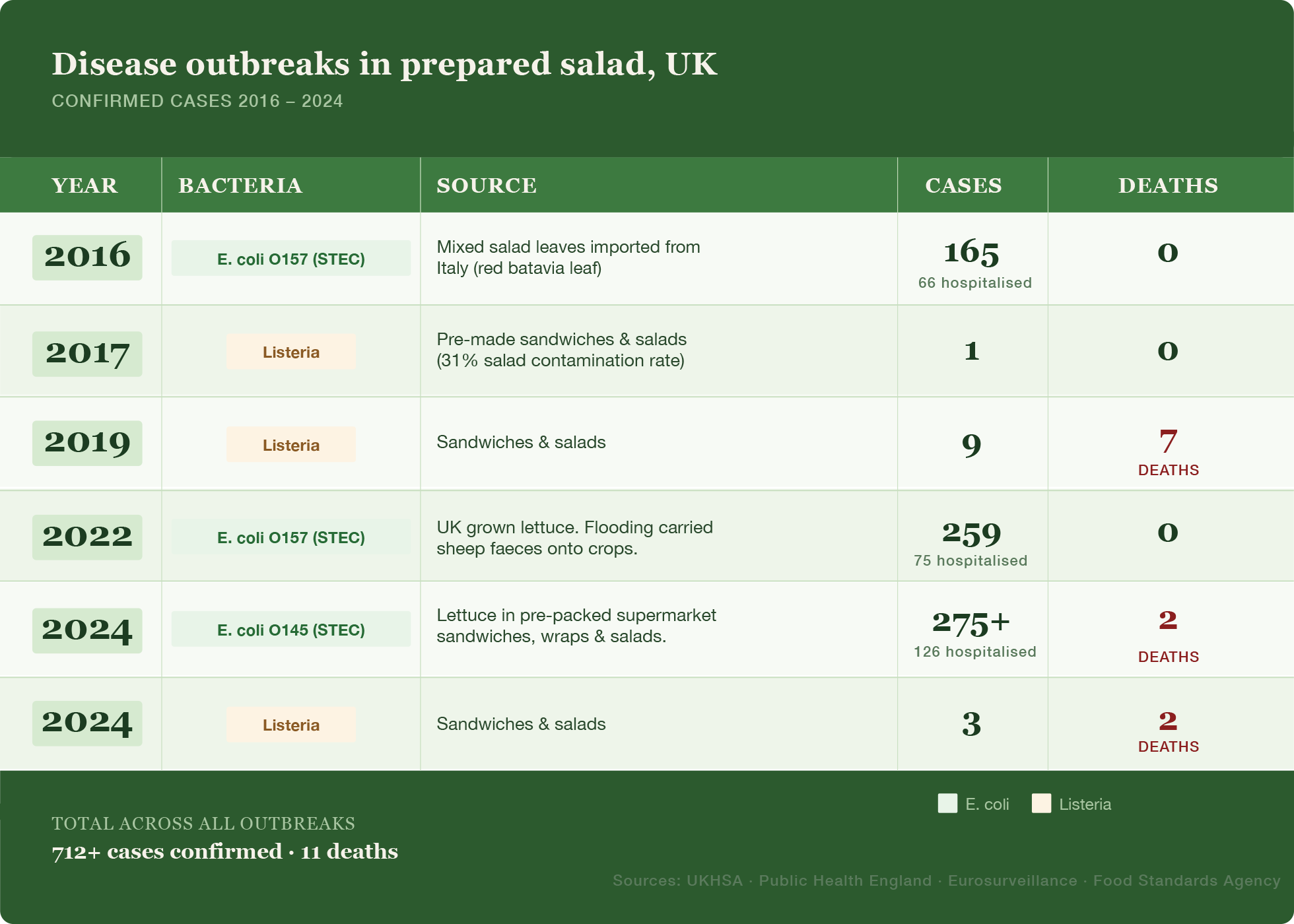
2016: E. coli O157, salad leaves Eurosurveillance
2017: Listeria, NHS sandwiches & salads Epidemiology and Infection journal
2019: Listeria, NHS Official PHE outbreak report
2022: E. coli O157, contaminated lettuce Official UKHSA outbreak report
2024: E. coli O145, sandwiches & salads Official UKHSA outbreak report
2024: Listeria, NHS FSA food alert
Is organic salad the answer?
Chlorine & peracetic acid washes are not cleared for use in organic production of salad bags because of concerns around synthetic residues & potential health effects. However, organic producers are still allowed to use chemicals like ozone & hydrogen peroxide, which are not known to leave residues on the leaves.
If a salad bag is organic then yes, the leaves were grown to organic standards but the leaves have still gone through the same process of cutting, washing & MAP packaging.
The same issues around nutrient decline & bacterial contamination still apply. In fact the 2024 Italian Salmonella outbreak, with 200 confirmed cases across 9 European countries, was due to contaminated organic rocket leaves.
Why leaves go bad so quickly
If you’ve ever bought a salad bag you’ve probably noticed the leaves turn rotten extremely quickly once you’ve opened it.
The MAP gas suppresses the decay process but even though the leaves look fresh in the bag it can’t hide the fact they were cut days & sometimes over a week before you bought them. MAP keeps the salad looking fresh but it doesn’t stop the natural process of breakdown that starts as soon as the leaves are cut. Notice that whole heads of salad don’t breakdown in the same way, it’s only when the leaves are cut & held in a synthetic atmosphere, as they are for salad bags.
The moment you open the bag you expose the contents to air & the decaying process catches up. Oxygen in the air reactivates the enzymes in the leaves that cause breakdown, while also accelerating bacterial growth. The juice from the cut leaves creates a humid environment inside the bag that speeds everything up & as they rot they release more juice, spreading bacteria to the remaining leaves & speeding up the whole process of decay.
That’s why a salad bag looks great on shelf but it might only last a few hours after opening.
How old is that salad?
Salad leaves are picked several days before they make it to the shelf & sometimes more than a week before. The leaves start losing their nutritional content as soon as they’re cut & they’re picked before nutrition & flavour have fully developed.
Up to 24 hours between harvest & starting transportation
Three days transport by road to the UK
24 - 48 hours being washed, processed & packed
Use-by date set five to seven days after packing
That’s up to 6 days just to get packed. But once packed, the product still needs to be sent to a regional distribution centre where it’s sorted then sent on to individual stores before being unboxed & displayed on shelf. That all adds time to the process. So even if you pick up something that looks fresh on shelf, it could be 10 days old already.
Pesticides
It’s usual for leaves in a salad bag to have had several applications of various pesticides. Although it’s hard to say exactly how many pesticide residues you might find on your salad leaves, to give you an idea of scale, the UK government’s own HSE surveillance programme tests for up to 423 different pesticides in each food sample it looks at. The majority of those pesticides have been created since WWII.
When multiple residues are present, you get what’s known as the cocktail effect. Research has shown that combinations of pesticides can disrupt hormone production & create cancer cells even when individual chemicals are within the set safety limits. The government sets safety limits for just one pesticide at a time but that doesn’t allow for the cocktail effect.
You’re eating & drinking combinations of foods & drink all day so you’re never exposed to just one chemical at a time. According to Anna Lennquist, a toxicologist at ChemSec, which advises on EU policy, we have hundreds of synthetic chemicals in our bodies. They’re not only from food but also from things like personal products, plastics & environmental pollution. Some chemicals enhance the effect of others & some work against each other. She also says “If you are exposed in the womb or during puberty, the effects can turn up many years later, even decades later, perhaps as breast cancers or different metabolic disorders.”
Clearly it’s your choice but be aware that while the lettuce on your plate might look fresh there’s a lot more going on that you don’t see.
So are supermarket salad bags safe?
Are supermarket salad bags safe? The honest answer is complex. To anyone that’s picked caterpillars & bugs off a lettuce, the salad bag seems like one of the great inventions of modern eating. There’s no question it’s convenient.
They're not going to kill you, most of the time. But with modified atmosphere packaging, chemical washing, pesticide residues & the two weeks they've potentially spent in transit, they're a long way from the fresh healthy choice they look like on shelf.
How you choose to eat is entirely up to you but once you know what's really going on inside that bag, you get to choose from a much better informed point of view.